 Climate change is no longer a future variable for Italian agri-food companies: it is already a measurable cost .
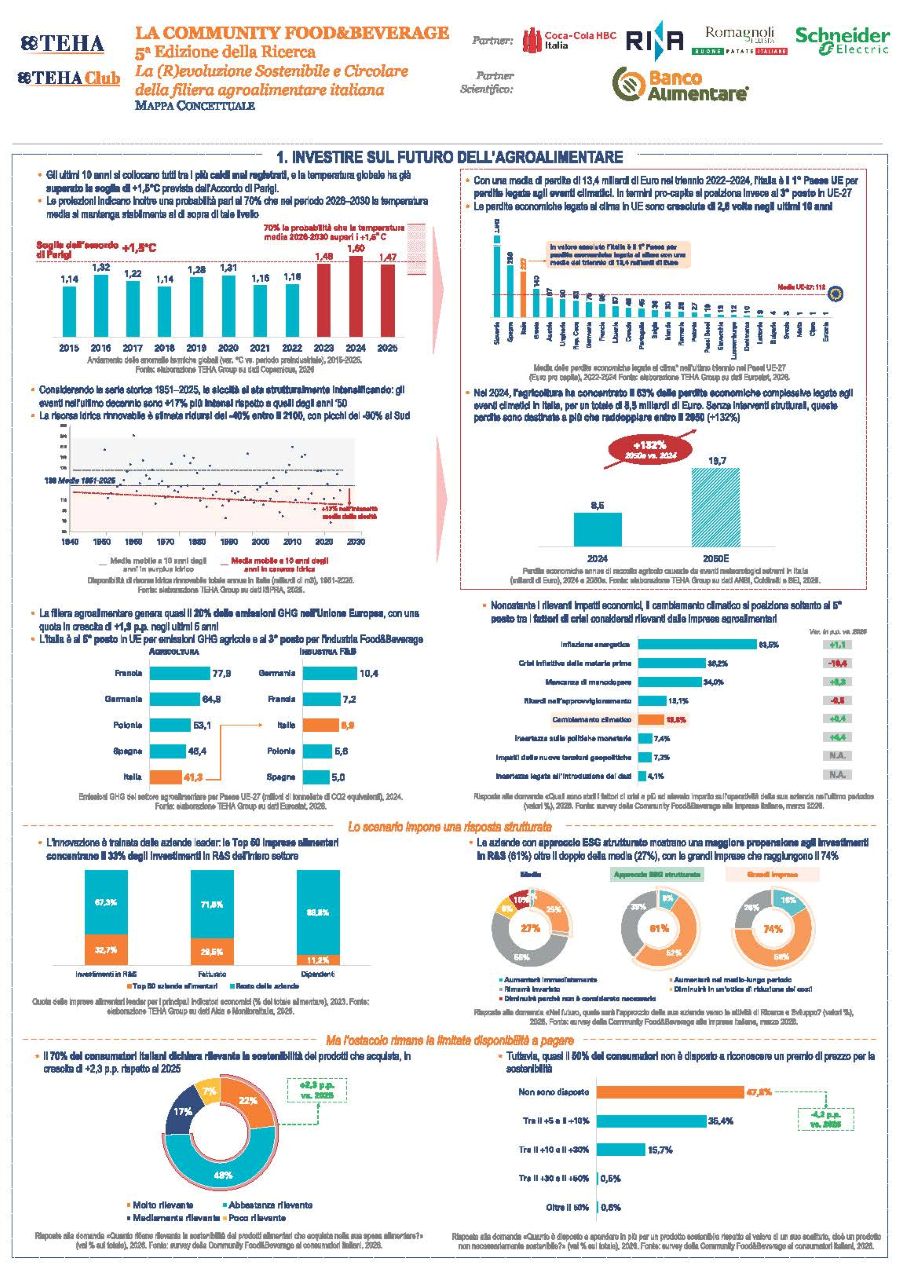
According to new research by the TEHA Group's Food & Beverage Community —"The Sustainable and Circular (R)evolution of the Italian agri-food supply chain" — Italy is the EU country with the highest economic losses related to climate events , with an average of €13.4 billion per year in the three-year period 2022–2024. In 2024, 63% of these losses were concentrated in the agricultural sector (€8.5 billion), and without structural interventions, this figure is expected to more than double by 2050 (+132%).
Climate rises in priorities, but not enough
Despite these numbers, climate change ranks only fifth among the crisis factors perceived by companies in the sector, preceded by energy inflation (63.5%), the raw materials crisis (36.2%) and labour shortages (34%).A sign that awareness exists, but that daily operational pressure risks distracting from the structural urgency.
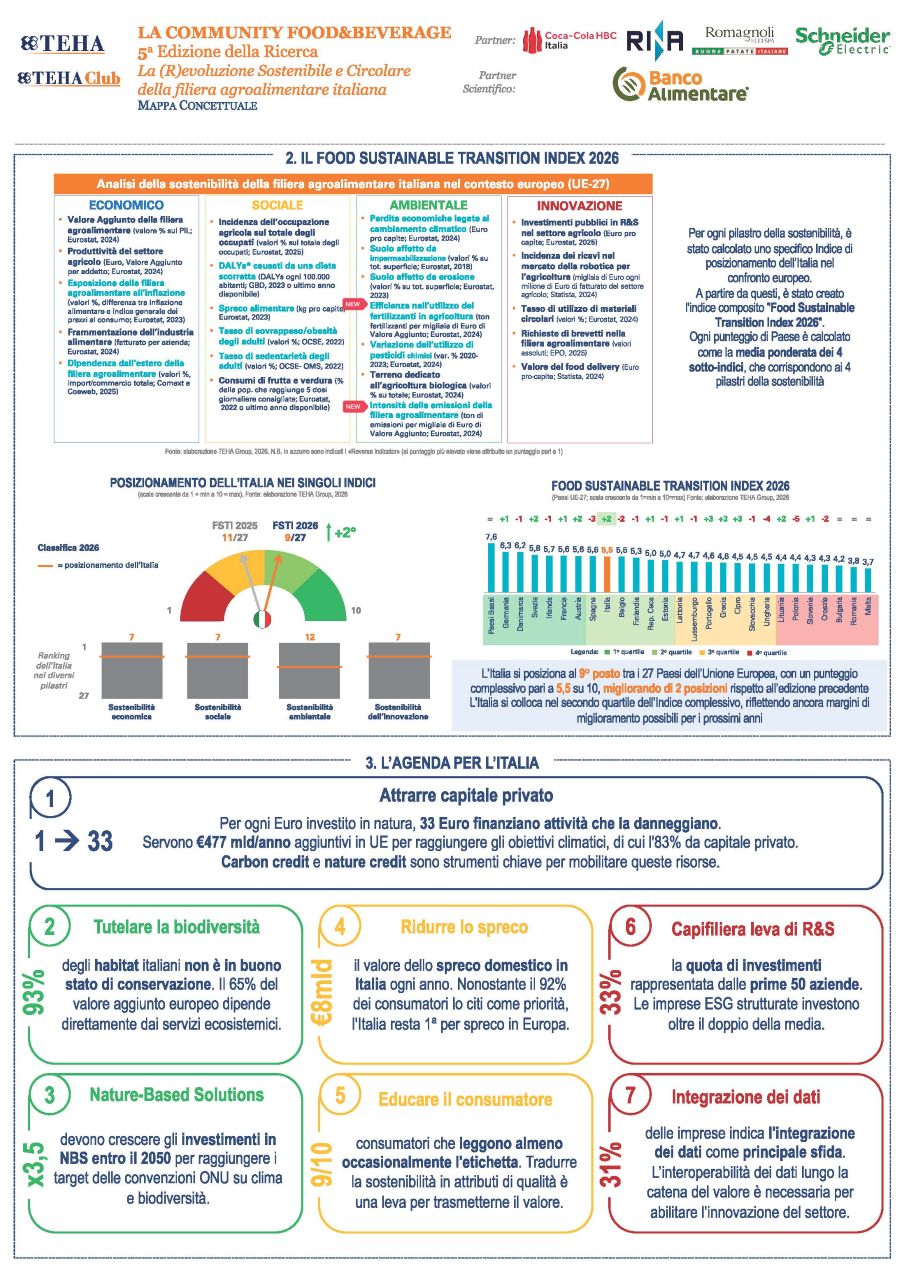
Italy ranks 9th in Europe for sustainable transition
The research introduces the Food Sustainable Transition Index 2026, a composite index that measures the sustainability of the agri-food supply chain in four dimensions :- economic,
- social,
- environmental
- of innovation.
Innovation driven by big companies, but still insufficient
The Top 50 food companies account for 33% of the entire sector's R&D investments .Companies with a structured ESG approach show a propensity to invest in research and development of 61%, more than double the sector average (27%), with large companies reaching 74%.
The message is clear: structuring sustainability isn't just business ethics, it's a competitive advantage.
The consumer wants sustainability, but doesn't want to pay for it
70% of Italian consumers say the sustainability of the products they purchase is important, an increase of 2.3 percentage points compared to 2025.However, 50% are not willing to recognize any price premium for sustainable products.
A paradox that companies must resolve by translating sustainability into perceptible attributes of quality, health, and territory.
The 7-priority agenda for businesses
The research proposes a concrete roadmap divided into seven axes of action:- Attracting private capital — The EU needs €477 billion a year to meet climate goals, with 83% coming from private sources. Carbon credits and nature credits are key levers.
- Protecting biodiversity — 93% of Italian habitats are not in a good state of conservation. 65% of Europe's added value depends directly on ecosystem services.
- Nature-Based Solutions — Investment in NBS must grow 3.5-fold by 2050.
- Reducing waste — Household waste is worth €8 billion a year. Italy remains first in Europe for waste, despite 92% of consumers considering it a priority.
- Educate consumers — 9 out of 10 consumers only occasionally read labels. Communicating sustainability in an understandable way is a valuable lever.
- Leading R&D — The top 50 companies account for 33% of investments. Structured ESG companies invest more than double the average.
- Data Integration — 31% of companies cite data interoperability across the value chain as the top challenge for enabling innovation.