
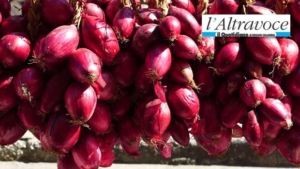
Among the many damages left by the recent violent cyclones that hit Calabria, there is one that, if not resolved quickly, could have very serious consequences for the regional agricultural sector , the second pillar of the Calabrian economy. This is the rupture of the pipeline that supplies part of the cultivation area of the Calabrian PGI Red Onion of Tropea , which runs along the border between the provinces of Cosenza and Catanzaro.
An event that may seem marginal, but, as we'll see, it isn't at all due to the serious repercussions for so many businesses. What's bringing tears to the eyes of farmers in this part of Calabria isn't the well-known effects of onions, but the dramatic situation created after the accident, with at least 500 hectares of crops deprived of water and the concrete threat of unprecedented economic and production losses .
[…]
"The situation is dramatic," explained Giuseppe Laria, president of the Consortium for the Protection of the Tropea Red Onion PGI. "The interruption in water supply is crucial for the cultivation of a product that is 90% water. Spring onions, a niche product, have already suffered serious consequences. We have no doubt that the Land Reclamation Consortium, which has direct jurisdiction over the matter, is committed to resolving the problem, but time is of the essence. If the broken pipe isn't replaced with a new one within a couple of weeks, the harvest will be definitively compromised. I want to emphasize that our onions are eagerly awaited by the market and cannot be replaced by other products that lack our quality characteristics."
[…]
The numbers involved are impressive. Certified regional production, according to CSQA , exceeded 20,000 tons in 2024, grown on approximately 1,000 hectares in the provinces of Vibo Valentia, Cosenza, and Catanzaro. The production value exceeds €20 million. The Vibo Valentia area accounts for a significant portion of production, with approximately 500-550 hectares cultivated, generating an annual production of 9-11,000 tons. The province of Cosenza, particularly the Campora San Giovanni area, follows, where approximately 300-350 hectares are cultivated, producing 5-7,000 tons. Finally, Catanzaro contributes 100-150 hectares, producing 2-3,000 tons annually.
[…]
Source: The Other Voice