
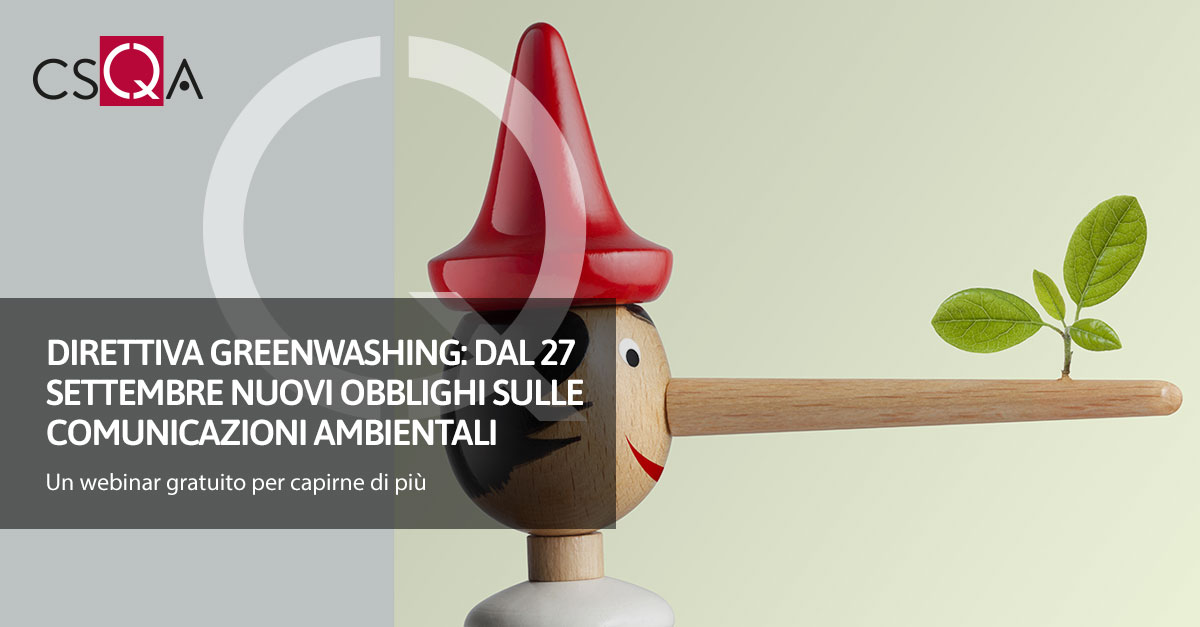
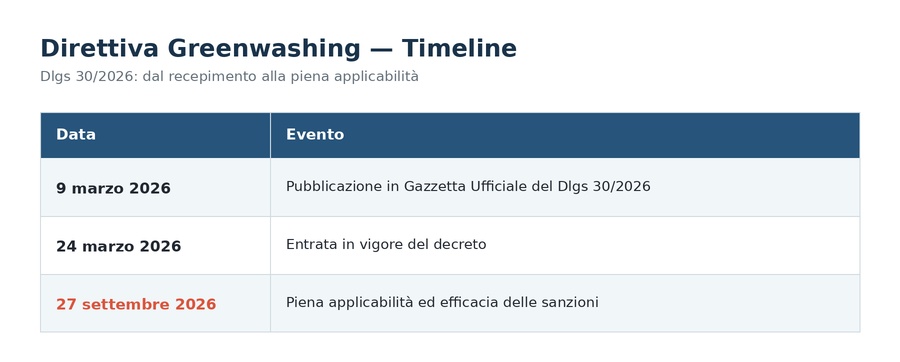
 Italy implemented Directive (EU) 2024/825—known as the "Greenwashing Directive" or "Empowering Consumers Directive" (EmpCo)—with Legislative Decree no. 30 of 20 February 2026, published in the Official Journal on 9 March 2026.
The decree has been formally in force since March 24, 2026, but the new provisions will become fully applicable from September 27, 2026: from that date, companies are required to comply, under penalty of sanctions.
What the decree changes
The measure profoundly modifies the Consumer Code, strengthening protection against misleading environmental claims used in commercial communications.Among the main new features:
- the prohibition on using generic or unsubstantiated statements,
- a more precise definition of "environmental claim" and "sustainability label",
- new information requirements on product durability and repairability.
Sustainability labels: stop self-certification
A key aspect of the Italian implementation concerns third-party certification : sustainability labels can no longer be "self-declared" or created internally without external verification based on recognized international or national standards.The new Legislative Decree, in fact, places third-party certification at the center as an essential tool for combating greenwashing.
Who supervises and what sanctions
Monitoring the application of the new rules is entrusted to the Italian Competition and Market Authority (AGCM) .The impact doesn't just concern large companies: the regulation applies to those who have relationships with end consumers but also to micro-enterprises , and it transversally affects company websites, packaging, product sheets and marketing materials in general.
A limit still open
An important aspect to keep in mind: Directive 2024/825 does not impose mandatory methodologies for verifying environmental claims, but only "qualitative" requirements.The separate , more technical and stringent Green Claims Directive was supposed to fill this gap — but European negotiations are currently suspended , which leaves companies with fewer specific operational guidelines on "how" to prove a claim, although the obligation to demonstrate it remains fully in force.
The connection with technical standards
The Directive also provides for a harmonized label to identify products covered by a commercial guarantee of durability, and the issues of durability/repairability/recyclability refer back to the concept of circularity.On this front, the UNI/TS 11820 technical standard (updated in 2024) already offers companies a structured method for measuring their organization's level of circularity with a final score.
 What to do right away
- Verify that environmental/social brands and claims in use are traceable to accredited certification schemes
- Eliminate generic formulations not supported by evidence ("green", "eco-friendly", etc.)
- Map all touchpoints at risk : website, packaging, product sheets, marketing materials
- Evaluate tools such as UNI/TS 11820 to document circularity
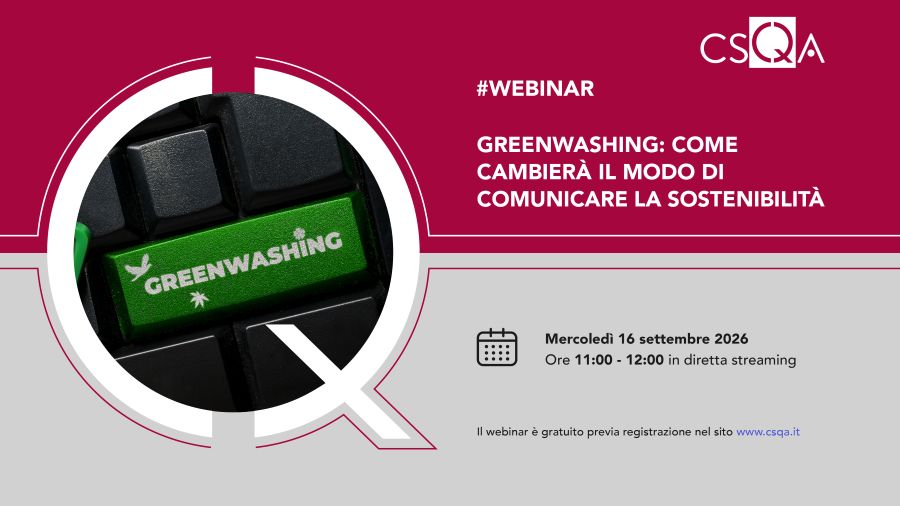
TO LEARN MORE, JOIN OUR FREE WEBINAR:
GREENWASHING: HOW THE WAY WE COMMUNICATE SUSTAINABILITY WILL CHANGE
September 16, 2026
.jpg "CSQA_Webinar_16Sett2026-(2).jpg")
The webinar offers a practical guide to the new regulations, with concrete examples of B2C communication, compliance criteria, analysis of the main greenwashing risks, and a focus on CSQA assessment, verification, and qualification services.