
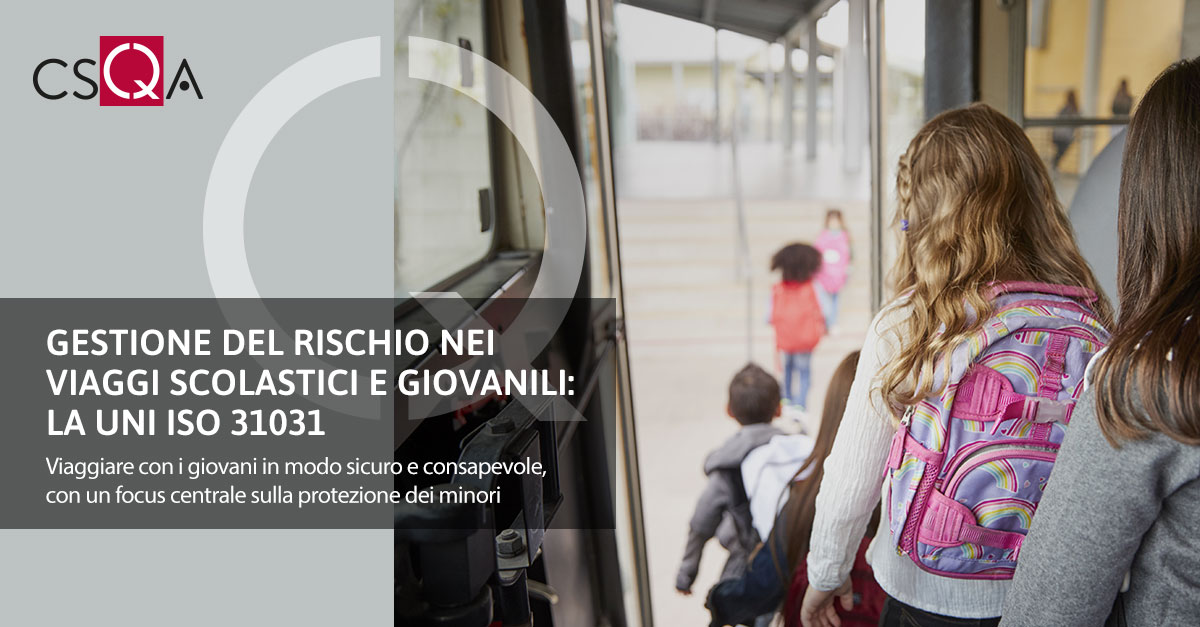
 Protecting young people on organized trips—school, educational, or cultural —is a fundamental responsibility for institutions, schools, training organizations, and industry professionals.
To provide an internationally recognized framework, UNI ISO 31031 has been published, a standard that defines comprehensive guidelines for risk management in youth travel, both nationally and internationally.
An international framework for managing risks professionally
ISO 31031 provides a comprehensive tool for identifying, assessing, and managing risks associated with the travel experiences of younger participants.Built on principles of diligence (“duty of care”) , the standard provides practical guidance for:
- carry out accurate risk assessments at the planning stage;
- define preventive measures and emergency plans;
- ensure supervision and assistance during all phases of the journey;
- deal promptly with unforeseen events;
- promote inclusion and accessibility.
Origin and development of the norm
The idea of a dedicated standard for this topic was born at the international level, with the aim of harmonizing approaches and best practices.In 2019, the ISO Committee on Consumer Policy (COPOLCO) unanimously approved the proposal to develop a specific standard for youth travel risk management.
The drafting of the text involved an international working group with experts in risk management, tourism, education, and safety, and benefited from a public consultation involving over 60 countries, helping to strengthen the quality and applicability of the standard.
UNI ISO 31031 is part of a broader framework of risk management tools, in line with:
- UNI ISO 31000:2018, which defines general principles and guidelines;
- UNI ISO 31030:2021, dedicated to risk management in business travel.
Guiding principles and practical application
At the heart of the standard is a person-centered approach: each journey is unique because the participants, contexts, and educational objectives are unique.For this reason, risk analysis starts from the participants' profiles and the specific characteristics of the activities and destinations.
The standard addresses often overlooked issues, such as:
- support for students with special educational needs or disabilities;
- managing cultural differences;
- transparent communication with families;
- the protection of the psycho-physical well-being of the participants.
Risk Management Process
The standard proposes a cyclical management model, oriented towards continuous improvement.The main suggested steps include:
- Leadership commitment , with the definition of clear risk management policies.
- Staff training and updating of support and monitoring skills.
- Preventive assessment and planning , with identification and analysis of specific risks.
- Communication with stakeholders, including families and partners.
- Active supervision during the trip and ability to adapt to emerging situations.
- Incident management according to defined plans.
- Post-event review , with feedback collection and practice improvement.