
 CSQA further strengthens its presence in the Italian quality agri-food system.
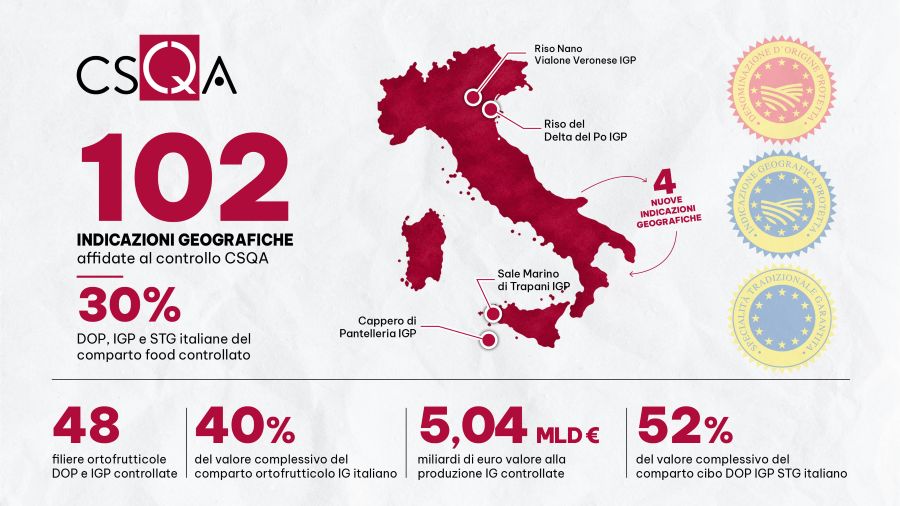
With the decrees of 15 September 2026, the Ministry of Agriculture, Food Sovereignty and Forestry authorized CSQA to carry out checks on four additional Geographical Indications:
- Pantelleria PGI Caper,
- Nano Vialone Veronese PGI rice,
- Po Delta PGI Rice
- Trapani PGI Sea Salt.
The dairy sector includes, among others, Grana Padano PDO, Gorgonzola PDO, Asiago PDO, Fontina PDO, Montasio PDO, Piave PDO, Provolone Valpadana PDO, Bitto PDO, and Valtellina Casera PDO; while the meat and processed products include denominations such as Prosciutto di Parma PDO, Culatello di Zibello PDO, and Bresaola della Valtellina PGI.
The fruit and vegetable sector is also particularly varied, with products including apples, pears, peaches, cherries, radicchio, asparagus, onions, garlic, chestnuts and legumes.
The four new supply chains further expand this presence. Specifically, Riso Nano Vialone Veronese PGI and Riso del Delta del Po PGI strengthen CSQA's presence in the cereal sector , which complements its already consolidated activity in the pasta sector, with Pasta di Gragnano PGI, Pizzoccheri della Valtellina PGI, and Maccheroncini di Campofilone PGI, and in the bakery sector, with Pane Toscano PDO and Pane di Matera PGI.
The Pantelleria Caper PGI expands the protection of plant products closely linked to their origin, while the Trapani Sea Salt PGI brings into the CSQA control system a supply chain with unique production characteristics and profoundly connected to its territory.
“The acquisition of these new Geographical Indications represents an important confirmation of the trust placed in the skills and experience gained by CSQA in the quality production sector,” declares Maria Chiara Ferrarese, General Manager and CEO of CSQA .
Each Geographical Indication preserves a heritage of knowledge, traditions, businesses, and communities that identify with a specific territory.
Our task is to ensure, through independent and rigorous monitoring activities, the credibility of this relationship, contributing to the protection of a heritage that represents a fundamental component of the Italian agri-food identity.
Supporting these supply chains means supporting the valorization of the products and the territories from which they originate, respecting the principles of transparency, competence, and impartiality that have always guided CSQA's work."
It should be remembered that behind every Geographical Indication lies a complex system of production regulations, companies, operators, protection consortia, and territories.
Third-party inspections are required to verify production compliance with established requirements over time, through specialized technical skills, process knowledge, and local presence.
The Geographical Indications controlled by CSQA today represent not only a dimensional achievement, but the expression of a wealth of expertise developed over time and put to the service of one of the most representative systems of the Italian agri-food sector.
.jpg "Infographic-CS-(1).jpg")