
"It's not just about ensuring a product is harmless and risk-free. This is a standard prerequisite," begins Sandro Luca Galasso, director of quality and food safety at Coop Italia . "Coop goes further, beyond the classic concept of food safety. It is committed to enriching it with values spread throughout the supply chain. While its founding values have always been expressed in this direction, it was in 2017, with the 'Alleviamo la Salute' campaign, that Coop formalized its commitment to animal welfare and the use of pharmaceuticals in livestock farming:
"We have progressively intervened across all the animal supply chains that supply Coop-branded products, providing our suppliers with clear guidance to achieve this goal," explains Antonella Donato, Food and Non-Food Quality Manager at Coop Italia . "The goal was to further improve farm conditions, preventing the onset of animal diseases and thus reducing the use of antibiotics, using them rationally when needed and eliminating them when not necessary."
[…]
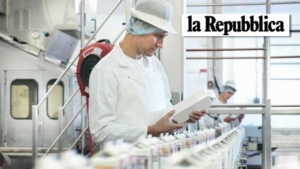
Ensuring goodness, freshness and safety is the commitment that Coop carries out together with Padania Alimenti, according to specific specifications that regulate the well-being and nutrition of dairy cows.
A symbol of life, milk, more than many other foods, has a universal appeal. For children and adults, for drinking or cooking, used both at home and in food processing plants, milk and its derivatives are suitable for every moment of the day. And that's also why it must, intrinsically, be good from every perspective. Operating since 1952 in the heart of the Po Valley, between Mantua, Cremona, Reggio Emilia, and Parma, Padania Alimenti has been a supplier of branded milk to Coop since 2004. "We collect milk daily from the 49 farms that produce for us in Cremona, Mantua, Brescia, Lodi, and Milan," explains Sergio Branchini, Quality Assurance Manager at Padania Alimenti. "Virtually all of ours are certified to produce high-quality milk. There are voluntary supply chains, such as the organic milk supply chain, which currently involves seven farms, and the one whose cornerstone is that dairy cows are fed feed that does not contain or derive from GMOs."
Once on the farm, the milk undergoes so-called gentle pasteurization, "for fresh milk at 74°C for 15 seconds, the same time for microfiltered milk but at 77°C," the manager specifies. "These temperatures do not cause nutritional, organoleptic, chemical, or physical damage to the milk, but above 70°C they reduce the bacterial load of pathogens. The good bacterial load remains, which is not harmful but rather healthy, but for which it is necessary to ensure the cold chain between 0 and 4°C." We are used to finding it like this, packaged and in the refrigerated section, but we never forget that milk comes from cows. And for it to be good, it is essential that the cows live well, so much so that all the farms in the Padania Alimenti supply chain are certified for animal welfare on farms according to CSQA specification 122 , known as Classyfarm .
A supplier of Coop-branded milk since 2004, Padania Alimenti has signed the specifications, as is the case for all branded products. "The milk we supply to Coop comes from a specific supply chain composed of eight farms that produce milk according to the agreed-upon specifications," explains Branchini. "There are several requirements, most notably the non-GMO diet for dairy cows and the procurement from feed mills certified to these standards. Meals and fats of animal origin cannot be fed to the cows on the farm, and all farms must be certified for animal welfare according to the Classyfarm standard. Furthermore, the Coop supply chain requires collection by separate trucks and unloading into a dedicated tank, as well as processing within a specific time slot to avoid cross-contamination."
[…]
Source: La Repubblica.it