
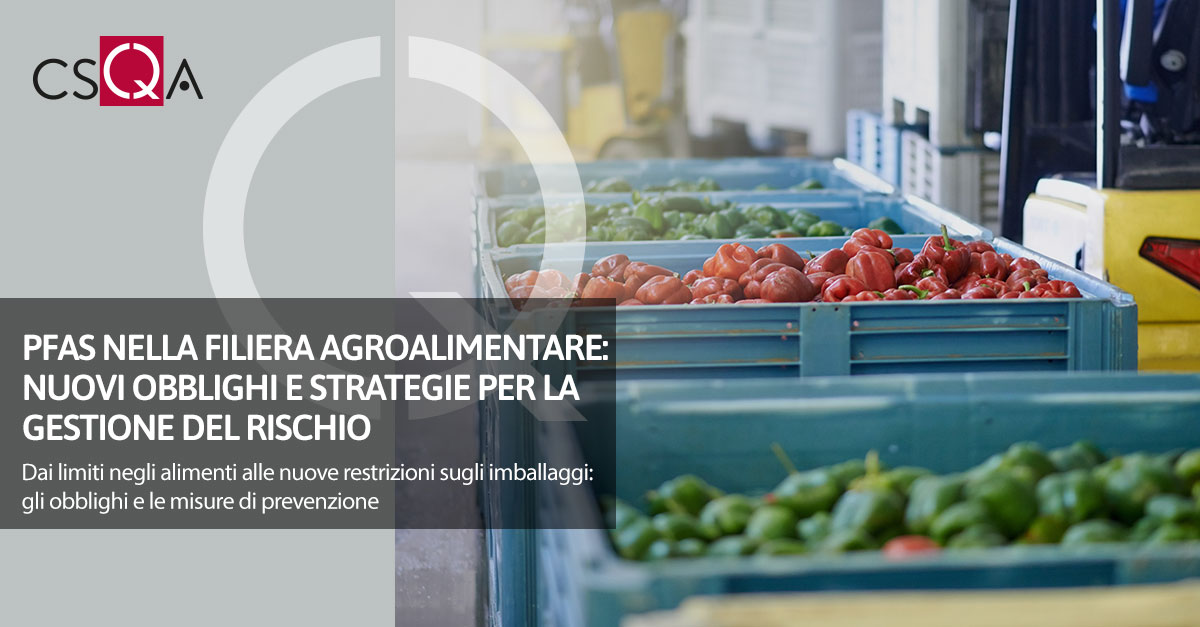
The presence of PFAS in the agri-food supply chain represents one of the emerging challenges for food safety, public health protection and regulatory compliance.
These substances, widely used in numerous industrial processes and materials, can enter the food chain through water, soil, feed, raw materials, food contact materials and, under certain conditions, processing equipment.
The European Union has progressively strengthened control measures, introducing maximum levels for certain food categories and, more recently, specific restrictions on packaging intended for food contact.
For agri-food businesses, it is therefore essential to adopt an approach that integrates risk assessment, supplier control, analytical monitoring and the updating of food safety management procedures.
What Are PFAS and Why Do They Pose a Risk?
Per- and polyfluoroalkyl substances (PFAS) are a large group of synthetic chemical compounds used for their resistance to water, grease and high temperatures.
Their high persistence in the environment has led to them being commonly referred to as forever chemicals. Some of these substances can accumulate in living organisms and contribute to human exposure through food.
According to the European Food Safety Authority (EFSA), prolonged exposure to certain PFAS may have adverse health effects, including changes in immune system response.
In 2020, EFSA established a tolerable weekly intake of 4.4 nanograms per kilogram of body weight, referring to the combined intake of four PFAS: PFOS, PFOA, PFNA and PFHxS.
This is a reference value for health risk assessment and is distinct from the legal maximum levels established for individual food categories.
PFAS in Food: What Limits Does EU Legislation Establish?
Regulation (EU) 2023/915, concerning maximum levels for certain contaminants in food, establishes specific limits for the four PFAS identified by EFSA, considered both individually and as a sum.
These limits apply to several product categories, including:
-
Meat and offal from various animal species.
-
Fish and fishery products.
-
Crustaceans and bivalve molluscs.
-
Eggs.
The maximum levels vary according to the food category and the substance concerned.
Alongside these maximum levels, Commission Implementing Regulation (EU) 2022/1428 establishes sampling and analytical methods for official controls, while Commission Recommendation (EU) 2022/1431 introduced a monitoring programme for the 2022–2025 period, aimed at collecting additional data on the presence of PFAS in different food matrices.
The European regulatory framework therefore reflects an approach combining legal limits, analytical controls and the collection of scientific data, including for foods not yet subject to specific maximum levels.
The absence of a numerical limit for a particular food matrix does not, however, eliminate the need to assess the associated risk under general food safety obligations.
Food Packaging: Restrictions Introduced by the New EU Regulation
One of the most significant developments for businesses concerns Regulation (EU) 2025/40 on Packaging and Packaging Waste (PPWR).
From 12 August 2026, specific restrictions apply to the placing on the market of food contact packaging containing PFAS at concentrations equal to or exceeding the thresholds established by the Regulation.
The thresholds are:
-
25 ppb for any individual PFAS measured through targeted analysis, excluding polymeric PFAS from quantification.
-
250 ppb for the sum of PFAS measured through targeted analysis, where applicable following the degradation of precursors, excluding polymeric PFAS from quantification.
-
50 ppm for PFAS, including polymeric PFAS, with specific provisions concerning the verification of fluorine content.
These restrictions are particularly relevant for packaging incorporating treatments or coatings designed to provide resistance to grease, moisture and other conditions of use.
For food businesses, packaging compliance has become an essential aspect to manage through supplier qualification, updated technical specifications and verification of the available documentation.
It is also important to consider that the risk of substances migrating from packaging materials into food may depend on actual conditions of use, including temperature, contact time and the characteristics of the packaged product.
How to Manage PFAS Risk Throughout the Agri-Food Supply Chain
Preventing contamination cannot be limited to testing finished products. It must involve the entire supply and production chain.
The first step is to integrate PFAS risk into the hazard analysis required under the HACCP system, assessing its relevance in relation to the nature of the business and the raw materials used.
The main areas requiring attention include:
1. Raw Materials and Geographical Origin
Assess potential exposure to environmental contamination, paying particular attention to products originating from areas where contamination of water or soil has been identified.
2. Water and Feed
Consider the potential transfer of PFAS through water used in production processes, irrigation and livestock farming, as well as through animal feed.
3. Suppliers and Food Contact Materials
Verify the characteristics of the materials used, obtain the relevant compliance documentation and update purchasing specifications in line with European regulatory requirements.
4. Production Processes and Equipment
Where relevant, assess the use of components and coatings that could represent potential sources of contamination.
5. Monitoring and Analytical Testing
Establish risk-based controls, identify the most relevant matrices and use laboratories with appropriate expertise and analytical methods.
6. Traceability and Non-Conformity Management
Ensure the ability to trace the origin of raw materials and materials, identify the causes of any contamination and promptly implement the necessary corrective actions.
The Role of Food Safety Management Systems
The evolving regulatory framework confirms the importance of food safety management systems capable of identifying, assessing and controlling emerging chemical risks.
PFAS risk can be integrated into existing corporate risk assessment processes through the tools already available within HACCP and food safety management systems, avoiding unnecessary controls or measures that are not justified by the characteristics of the supply chain.
In this context, certification standards and schemes such as ISO 22000, FSSC 22000, BRCGS and IFS Food provide useful frameworks for structuring hazard analysis, supplier management, process verification and continual improvement.
Certification does not replace regulatory obligations or automatically guarantee the absence of PFAS. However, it can help strengthen the organisation of controls and a company's ability to document the measures implemented.
For agri-food businesses, managing PFAS risk therefore means going beyond mere compliance with legal limits, adopting a prevention and control system that encompasses suppliers, processes, materials and products.
This approach is becoming increasingly important for protecting food safety, ensuring regulatory compliance and strengthening the trust of customers and consumers.