
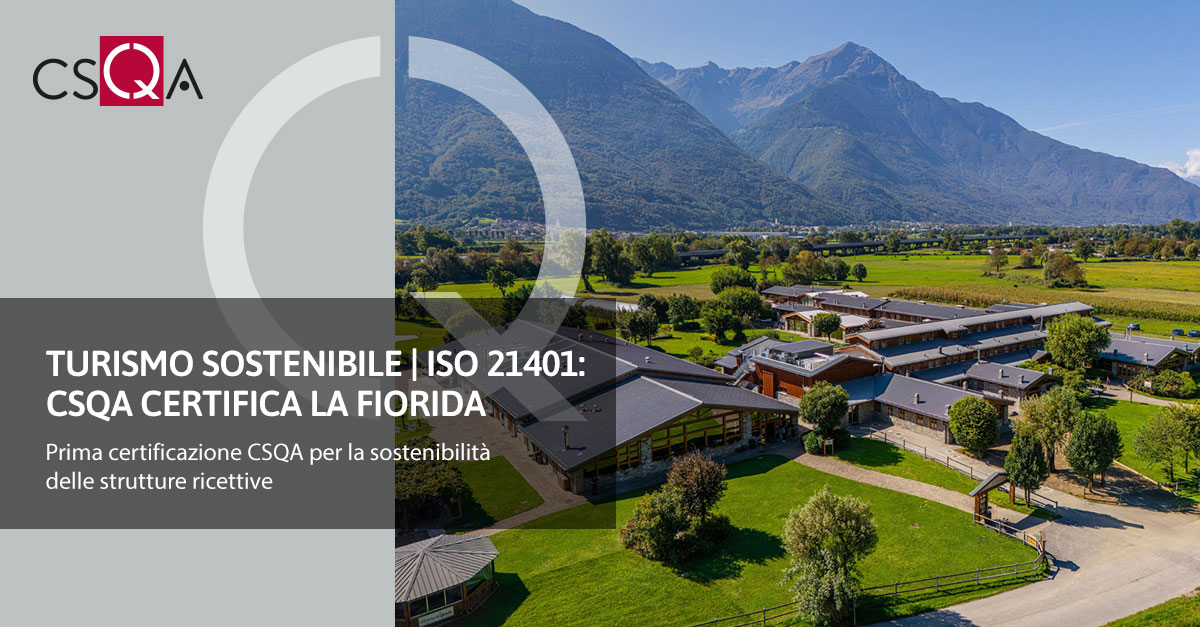
La Fiorida Agri Relais is the first accommodation establishment to be certified by CSQA according to UNI ISO 21401, the international standard for sustainability management systems for accommodation establishments.
This achievement recognizes the efforts undertaken by the Valtellina-based company to integrate environmental, social and economic sustainability into its management model in a structured and verifiable way.
Located in Mantello, in Valtellina, La Fiorida is an agricultural and agritourism business where livestock farming, crop cultivation, food processing, catering and hospitality are closely integrated.
The business project developed by the Vanini family has grown around this connection: from animal care to the processing of raw materials in the company's own dairy and meat-processing facilities, through to their use in its kitchens and the experiences offered to guests.
This integrated supply chain makes agricultural production an essential part of the establishment's identity and hospitality experience.
This approach led to the decision to adopt UNI ISO 21401, consolidating practices already in place within the organization through a management system that enables environmental, social and economic performance to be monitored, objectives to be established and their achievement to be assessed over time.
FROM COMMITMENT TO MEASURABLE SUSTAINABILITY
La Fiorida's certification journey was designed to enhance its established sustainable management practices, measure and monitor environmental, social and economic performance, strengthen transparency towards guests, employees and local stakeholders, and adopt a model focused on continual improvement.
UNI ISO 21401 addresses the three pillars of sustainability — environmental, social and economic — through an integrated approach.
From an environmental perspective, the management system considers aspects such as efficient energy and water use, waste prevention and reduction, and the protection of biodiversity and the landscape.
At La Fiorida, this approach builds on concrete measures already implemented, including solar panels, a woodchip-fired biomass boiler and a biogas plant powered by cattle manure, alongside the promotion of in-house agricultural production and short supply chains. Animal welfare is also a key consideration in livestock management and the development of the company's facilities.
The social dimension encompasses employee well-being and occupational safety, training and staff engagement, as well as relationships with local communities.
At La Fiorida, the transmission of agricultural knowledge and traditions is also reflected in guided visits and educational activities, which introduce guests to the company's daily operations, the origins of food and the agricultural heritage of the local area.
From an economic perspective, the focus is on business continuity and the company's relationship with the local economy. The integration of agricultural production and hospitality, together with partnerships with local producers and craftspeople, helps promote local expertise and supply chains while supporting a tourism model capable of generating long-term value.
“For La Fiorida, this certification represents a milestone in a journey built over the years through our daily work and decisions,” says Viola Vanini, Sole Director and Legal Representative of La Fiorida. “Our hospitality is rooted in the land, livestock farming and the people who contribute every day to bringing our business to life. We have chosen to strengthen this commitment through clear objectives and tools that help us measure progress and identify areas for improvement. It is a responsibility we feel towards our employees, our guests and the local area of which we are part.”
A SHARED CERTIFICATION JOURNEY
The certification was issued following an assessment process conducted by CSQA through independent audits and verifications of the management system, against the requirements of the standard and within the defined certification scope.
The audit process required significant involvement from top management and the company's main business functions.
Commitments were formalized in the company policy and translated into specific sustainability objectives.
The involvement of operational teams and employees working directly with guests helped integrate sustainability objectives into the day-to-day management of services and hospitality operations.
In this context, the close connection between accommodation services, livestock farming and dairy production is one of the distinctive features of La Fiorida's business model. These activities are an essential part of the company's production operations and help shape both its gastronomic offering and the opportunities provided to guests to discover local agricultural traditions.
CERTIFICATION AS A TOOL FOR BUILDING TRUST
Management system certification therefore provides La Fiorida with a means of demonstrating its sustainability journey and commitments, strengthening transparency towards guests, tourism operators, employees and the local community.
“La Fiorida's certification represents a significant milestone because it demonstrates how sustainability in the tourism sector can be transformed from a general principle into a concrete management system,” says Maria Chiara Ferrarese, General Manager and Chief Executive Officer of CSQA. “UNI ISO 21401 enables organizations to address environmental, social and economic aspects in an integrated manner, embedding sustainability into their decision-making and operational processes.
Independent third-party assessment adds a fundamental element: it makes it possible to demonstrate commitments and results against recognized and verifiable criteria. In a sector deeply connected to local areas and communities, certification can therefore become a tool for building trust and transparency, as well as a driver of continual improvement and business competitiveness.”
For La Fiorida, achieving certification therefore strengthens the connection between its business vision, operational practices and the experience offered to guests. Independent verification of the management system supports a journey focused on continual improvement within the scope defined by the certificate.
For CSQA, this first UNI ISO 21401 certification also represents a further step in the development of assessment tools capable of supporting businesses and local communities in adopting development models where sustainability, quality and competitiveness can advance together.