
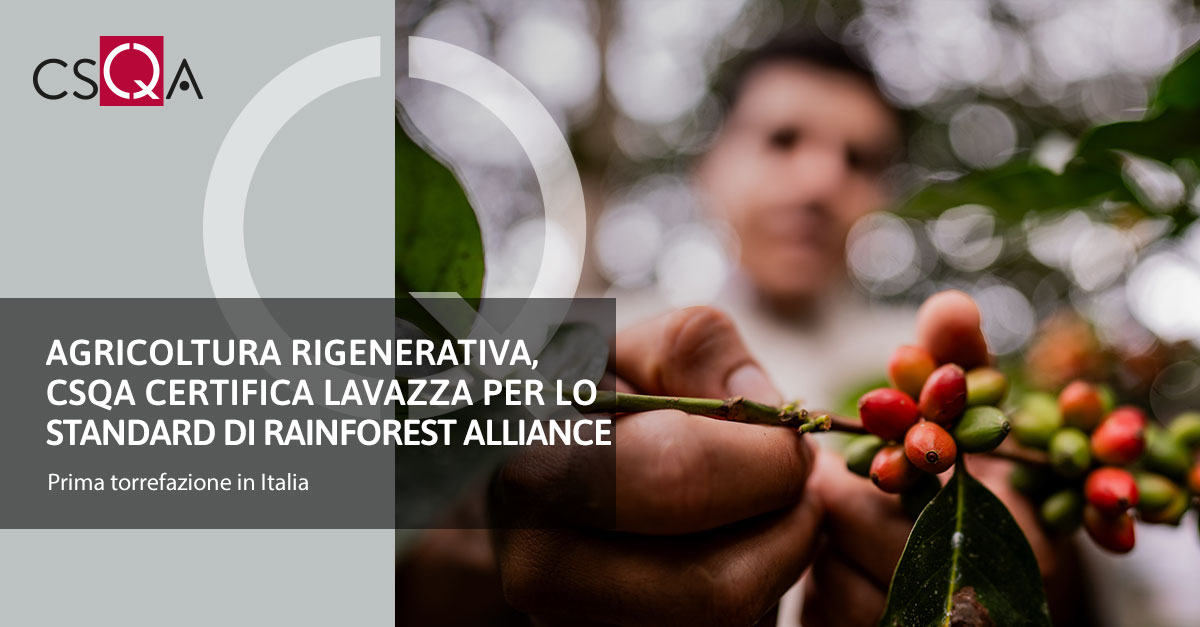
 Another important milestone in the journey towards increasingly sustainable and resilient coffee supply chains: CSQA has certified Lavazza according to the Rainforest Alliance Regenerative Agriculture Standard , the standard dedicated to promoting and verifying regenerative agriculture practices.
Rainforest Alliance Regenerative Agriculture Standard
Published by the Rainforest Alliance in September 2025 and effective March 1, 2026, the Regenerative Agriculture Standard provides farmers and supply chain operators with a structured and verifiable framework for adopting and leveraging regenerative agriculture practices.The approach goes beyond simply reducing the impacts of agricultural activity: the goal is to promote the recovery and improvement of ecosystem functionality, while at the same time strengthening farms' ability to address the effects of climate change.
The Standard focuses specifically on three nature-related impact areas – soil health and fertility, biodiversity, and climate resilience – while maintaining important social requirements.
The key points of the regenerative approach
The model promoted by Rainforest Alliance focuses on some fundamental elements:- Soil health and fertility : increase soil cover and organic matter, promoting soil fertility and regeneration capacity.
- Climate resilience : Using agroforestry, resilient varieties, and other practices that help crops cope with drought, floods, and other climate impacts.
- Biodiversity : Increase natural vegetation and tree cover, creating favorable conditions for pollinators, wildlife, and other organisms.
- Water Management : Protect water sources through buffer zones, efficient irrigation systems, and rainwater harvesting.
- People and Communities : Strengthening farmers' livelihoods and respect for human rights, linking environmental regeneration to the social and economic sustainability of farming communities.
Lavazza: Regenerative Agriculture from Plantation to Cup
The collaboration between Lavazza and the Rainforest Alliance, active for over twenty years, has made it possible to translate these principles into concrete interventions on the ground.In Honduras , in the Siguatepeque area, Lavazza directly supported agricultural companies on the path towards the new Rainforest Alliance Regenerative Agriculture Certification through training and technical assistance .
The first phase of implementation has already allowed 73 farms to obtain certification according to the Regenerative Agriculture Standard.
A path that also finds expression on the market with La Reserva de ¡Tierra! Selection, a 100% Arabica blend intended for coffee professionals.
The product uses coffee from farms in Honduras and Brazil certified according to both the Rainforest Alliance Sustainable Agriculture Standard and the Regenerative Agriculture Standard.
The Reserva de ¡Tierra! Selection is the first coffee aimed at the professional market from farms certified according to the new Standard.
The role of CSQA
CSQA's activity fits into this process, having certified Lavazza under the Rainforest Alliance scheme.Independent verification represents a fundamental element in giving concreteness, measurability and credibility to sustainability and regeneration commitments along the supply chain , allowing organizations to demonstrate the application of the requirements set out in the scheme.
Lavazza's certification also confirms CSQA's role in supporting organizations and agri-food supply chains in adopting production models capable of integrating environmental sustainability, climate resilience, protection of natural resources, and attention to communities.
For more information: the LifeGate podcast
A special episode of LifeGate's podcast "News from Planet Earth," produced with the support of Lavazza and recorded at the Nuvola Lavazza in Turin, is also dedicated to regenerative agriculture and Lavazza's experience.Through three episodes, the podcast explores the topic from complementary perspectives: soil regeneration and health, the practical application of regenerative practices in crops, and the effects on farming communities.
An opportunity to better understand how regenerative agriculture can move from principles to concrete application along the coffee supply chain and the role standards and certifications can play in making this process verifiable.
Listen to the podcast "News from Planet Earth" dedicated to regenerative agriculture