
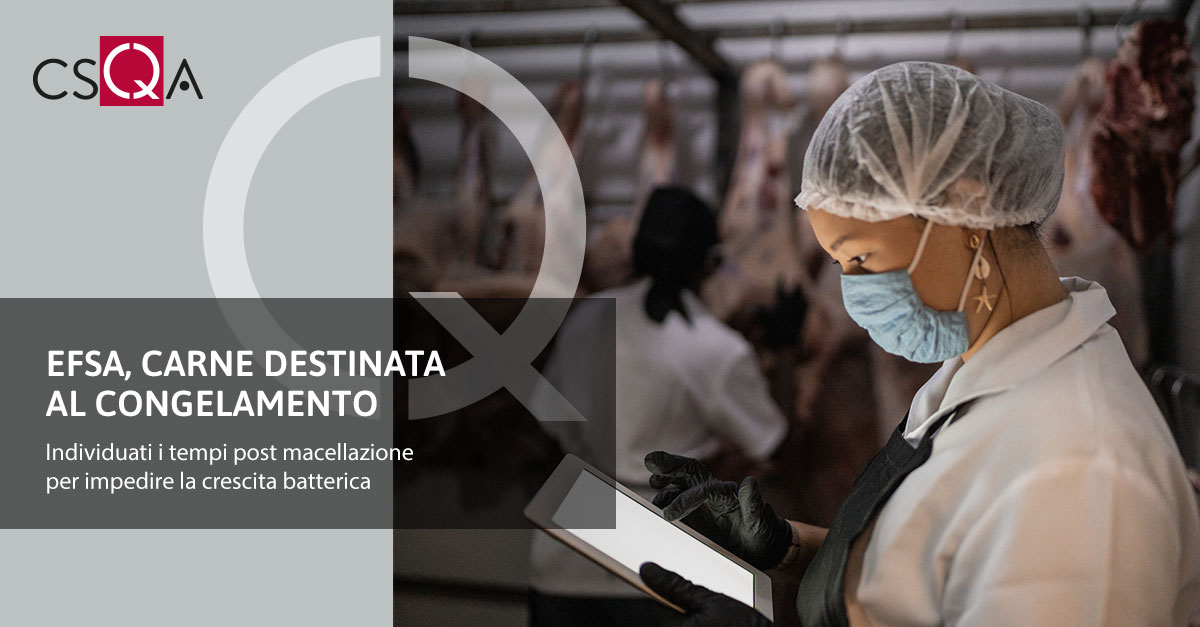
 The European Food Safety Authority ( EFSA ) has assessed how bacteria grow in beef, sheep and pork during refrigeration, storage and thawing .
In particular, EFSA experts examined how storage conditions (temperature, vacuum packaging) and the time factor can influence microbial growth in the period between slaughter and freezing, as well as during subsequent defrosting and storage.
In the published study—Microbiological safety of ungulate meat intended to be frozen and defrosting of frozen ungulate meat —experts concluded that the way meat is stored by food business operators before it reaches consumers can influence bacterial growth.
This applies to both harmful bacteria such as Salmonella and Listeria, as well as those that affect the smell and appearance of meat.
Scenarios compared
The experts adopted a reference scenario (meat stored, without vacuum packaging, at 7°C for 15 days) and compared it with various meat storage and thawing scenarios, to observe the differences in microbial growth.Using mathematical models and the time equivalence criterion, the experts were able to establish how long the meat can be stored before freezing , until it reaches the same microbial levels as the reference scenario.
Main results
- When meat was stored at 7°C and vacuum- packed immediately after stabilization, the equivalence time before freezing was determined by Salmonella and was achieved within 5–6 days of post-slaughter storage.
- When meat was stored at 3°C, the equivalence time before freezing was determined by spoilage lactic acid bacteria and was reached 29–30 days after slaughter. In some situations, when the initial bacterial contamination of the meat is high, spoilage may occur before the expected equivalence times are reached.
- When thawing the meat at 4°C or 7°C under the conditions evaluated, bacterial growth was absent or limited.
- Further storage of meat at 4°C for up to 7 days after thawing may lead to further bacterial growth depending on storage conditions, suggesting that pre-freezing times in some scenarios should be reduced to achieve equivalence with the reference scenario.