
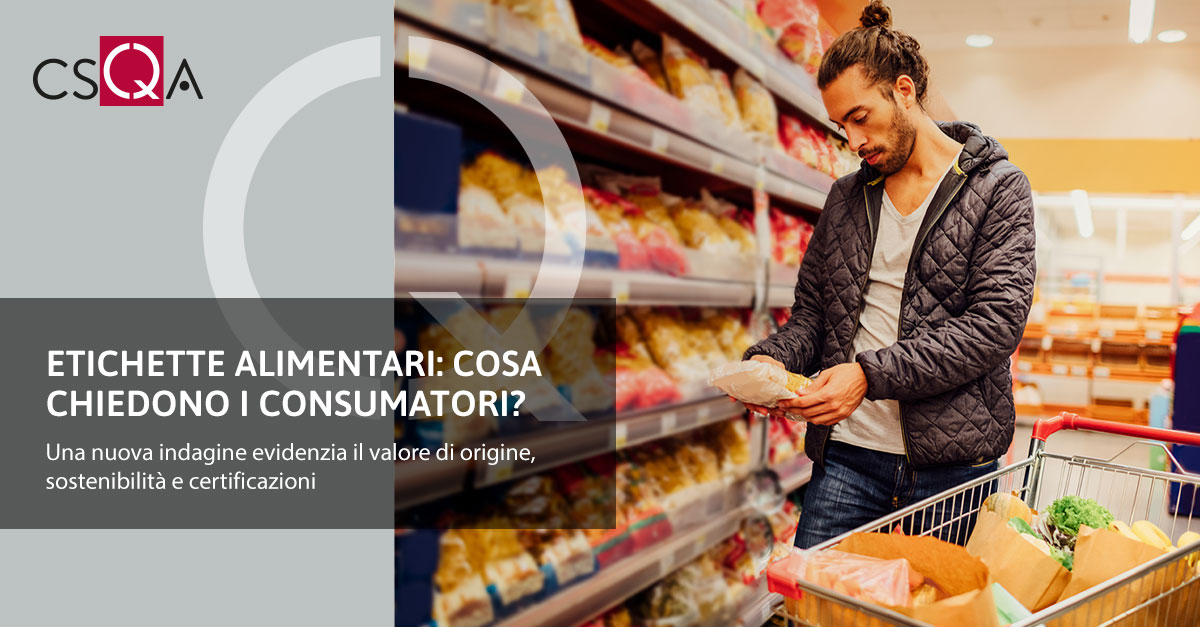
Origin of raw materials, environmental and social sustainability, clear and verifiable information: these are the elements that consumers increasingly want to find on food labels.
This is what emerges from a survey conducted by Fondazione Openpolis for Federconsumatori, as part of the Italians Do EAT Better (IDEA B) project, funded by the Italian Ministry of Enterprises and Made in Italy and presented in Rome on 27 October 2026.
The survey, based on a questionnaire involving 858 respondents, highlights a strong focus on transparency in agri-food supply chains and the credibility of information provided on product packaging.
For companies operating in the sector, the findings provide valuable insights into evolving consumer expectations and the role that traceability, certifications and communication can play in strengthening trust in products.
Food Origin: Consumers' Top Priority
The most significant finding concerns product origin: 96.4% of respondents support extending mandatory origin labelling to all food products, while 62% believe that the information currently available is insufficient.
The origin of raw materials remains one of the most sought-after pieces of information on packaging, alongside expiry dates and ingredient lists.
The survey also reveals that:
-
84.9% often or always read food labels before purchasing.
-
56.7% check the origin of raw materials.
-
53.3% believe that the language used on labels is not entirely clear.
-
Only 24.3% can find and understand the information without difficulty.
These findings confirm the importance of communication that makes technical and regulatory information accessible without compromising accuracy.
For agri-food businesses, transparency regarding origin represents an opportunity to enhance product value, particularly when information is supported by reliable traceability and control systems.
Sustainability: Not Just the Environment, but Workers' Rights Too
Another key aspect concerns how consumers understand food sustainability.
According to the survey, consumers primarily associate sustainable food products with three characteristics:
-
Local production (62.4%), reflecting a connection with the local area.
-
Respect for workers' rights and fair remuneration (58.6%), confirming growing attention to the social dimension of sustainability.
-
Absence of chemical pesticides (57.9%), perceived as an element of environmental sustainability.
These are perceptions expressed by respondents and do not necessarily correspond to the technical criteria used to assess a product's sustainability.
Particularly significant is the gap between consumer interest and the ability to identify sustainable food products: only 13.7% say they can often recognise them through the information provided on labels.
Furthermore, just 1.3% believe that sustainable food must necessarily cost more.
The findings highlight a challenge for the agri-food sector: making environmental and social commitments recognisable and understandable, through information based on objective and verifiable criteria.
Certifications and Quality Labels Influence Purchasing Decisions
The survey pays particular attention to the role of certifications and quality labels displayed on packaging.
40.6% of respondents consider certifications very important when choosing a food product.
Among the most widely recognised labels are Geographical Indications and organic certification.
|
Label |
Recognition |
Influence on Purchasing Decisions |
|---|---|---|
|
PDO |
89.0% |
72.4% |
|
PGI |
86.5% |
70.2% |
|
Organic |
86.0% |
72.4% |
|
MSC |
42.2% |
47.9% |
|
TSG |
17.3% |
24.0% |
These figures confirm the communication value of recognised quality schemes, while also highlighting the importance of correctly explaining what these labels mean and the guarantees they actually provide.
Certification, when based on defined requirements and independent assessments, is a fundamental tool for lending credibility to companies' claims, distinguishing verified commitments from simple promotional statements.
For businesses, effectively communicating certifications therefore means not only making their products more recognisable, but also transparently explaining the compliance and assessment processes underpinning them.
Clearer Labels and More Understandable Nutritional Information
The survey also highlights difficulties in understanding nutritional information.
76% of respondents are unfamiliar with both Nutri-Score and NutrInform Battery, the two nutritional labelling systems at the centre of the European debate.
Beyond the differences between these systems, the findings primarily reveal the need for information that is easy to locate and understand.
Clarity is particularly important for people following specific diets for health reasons, allergies or intolerances.
For companies, the correct management of mandatory information, allergens and nutritional declarations therefore remains essential to food safety and consumer protection.
What This Means for Agri-Food Businesses
The findings of the survey come at a time when information transparency is becoming increasingly important, also in light of evolving European legislation on environmental communication and consumer protection.
For businesses, several priorities stand out:
-
Strengthen supply chain traceability to ensure reliable information on the origin and provenance of raw materials.
-
Verify the accuracy of food labels, ensuring regulatory compliance, readability and clarity.
-
Document environmental and social performance, avoiding generic claims that are not supported by evidence.
-
Promote recognised certifications, correctly communicating their meaning, requirements and scope.
-
Prevent greenwashing through sustainability claims that are accurate, substantiated and consistent with the product's actual characteristics.
In this context, certification schemes and independent assessments can help strengthen the reliability of information, supporting businesses in communicating the quality, origin and sustainability commitments associated with their products.
CSQA Services to Meet Evolving Consumer Expectations
Certified origin, traceability, sustainability and food safety are areas in which CSQA supports agri-food businesses through certification services, independent verification and tools designed to enhance the value of supply chains.
In particular, CSQA carries out controls on PDO, PGI and TSG products, as well as organic certification and National Quality Schemes, helping to promote product origin, production methods and distinctive characteristics.
Through ISO 22005 certification and traceability services, CSQA also supports companies in managing and verifying information throughout the supply chain, promoting more transparent communication with consumers.
In the field of environmental and social sustainability, CSQA offers certifications and verification services relating to good agricultural practices, integrated production, biodiversity, environmental footprint and social responsibility, as well as Green Claims Assurance services to strengthen the reliability of environmental claims.
These services are complemented by food safety certifications, including IFS Food, BRCGS Food and FSSC 22000, which help strengthen production process controls and trust throughout the supply chain.
Through independent verification of requirements and performance, CSQA helps businesses turn their stated commitments into verifiable assurances, responding to growing consumer demand for transparency, quality and sustainability.
Transparency as a Competitive Advantage
The Federconsumatori–Openpolis survey delivers an important message for the agri-food sector: consumers are not simply asking for more information, but for information that is clear, reliable and easily verifiable.
For businesses, meeting these expectations means going beyond mandatory labelling requirements by investing in supply chain knowledge, performance measurement and the credibility of their claims.
Independent certification can play a strategic role in this process, helping to turn transparency into a distinctive factor of quality, trust and competitiveness.