
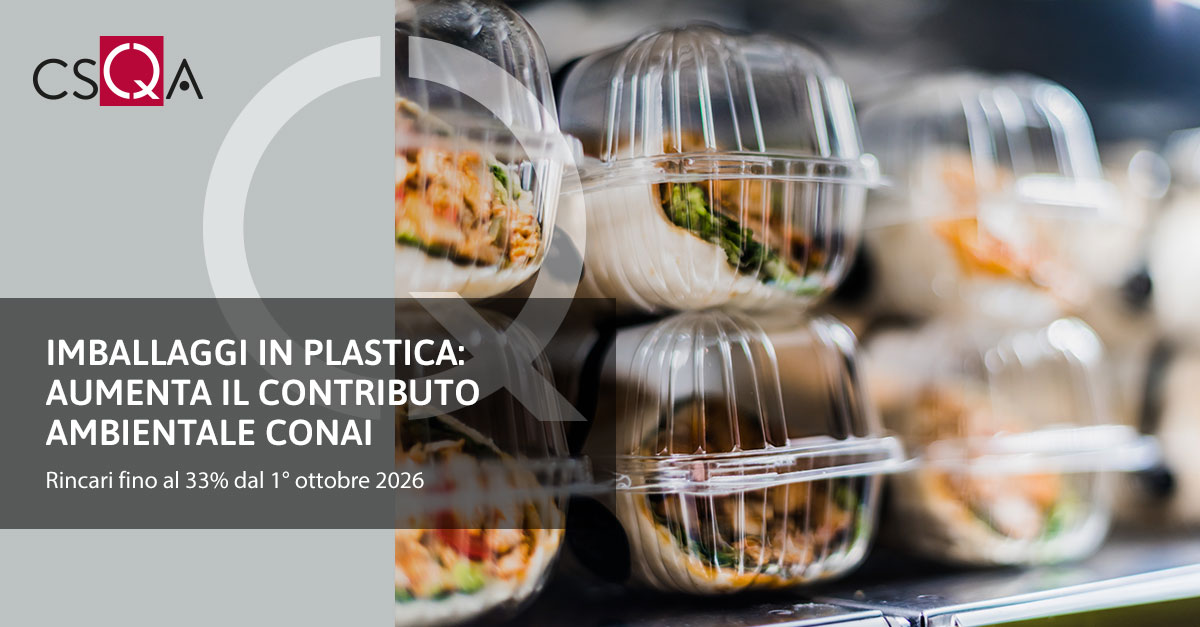
 The new CONAI Environmental Contribution (CAC) values for plastic packaging will come into force on 1 October 2026 , with increases affecting all contribution brackets and directly impacting the costs incurred by companies that purchase and use packaging.
The review, defined by the CONAI Board of Directors together with the Corepla consortium, comes in response to a critical phase for the plastics recycling sector , characterised by rising costs and unstable markets.
What concretely changes for companies
Although the CAC is formally borne by packaging producers and importers, the increase will be passed on along the supply chain , impacting the prices of materials and therefore the procurement costs of user companies (industry, retail, logistics).The increases will be differentiated, but widespread:
- increases from +2% up to +33% , depending on the type of packaging
- higher price increases for less recyclable packaging or packaging with lower recovery value
- PET containers (bottles and containers) → up to +33%
- less sustainable bands (B2 and C) → marked increases up to over €900/t
Why contributions are increasing
The decision is linked to a structural crisis in the recycling supply chain , which also directly impacts packaging users.In particular, they weigh:
- increased costs of collection, sorting and recycling
- growth in waste volumes managed by the consortium system
- weakness in demand for recycled plastic , especially for certain types.
Added to this is the growing competition from virgin and recycled materials from outside the EU, which is reducing the competitiveness of European recycling and squeezing its economic margins.
Economic impact: what to expect
For downstream companies , the main effect will be:- increase in the prices of purchased packaging
- possible revision of contracts with suppliers
- increased pressure on margins , especially in packaging-intensive sectors
Opportunity: a lever to rethink packaging
At the same time, the CONAI system continues to encourage more sustainable choices:- the contribution remains lower for easily recyclable packaging
- higher for complex or difficult to value ones
- choose single-material packaging
- reduce the weight and complexity of packaging
- collaborate with suppliers on eco-design solutions
A scenario to monitor
The postponed entry into force until October 2026 was intended to give businesses time to adapt, but the situation remains uncertain.The recycling sector is still exposed to market volatility, geopolitical dynamics, and regulatory developments at the European level.
In this context, companies that use packaging will have to increasingly integrate packaging into their cost and sustainability strategies, anticipating possible further revisions in the coming years.