
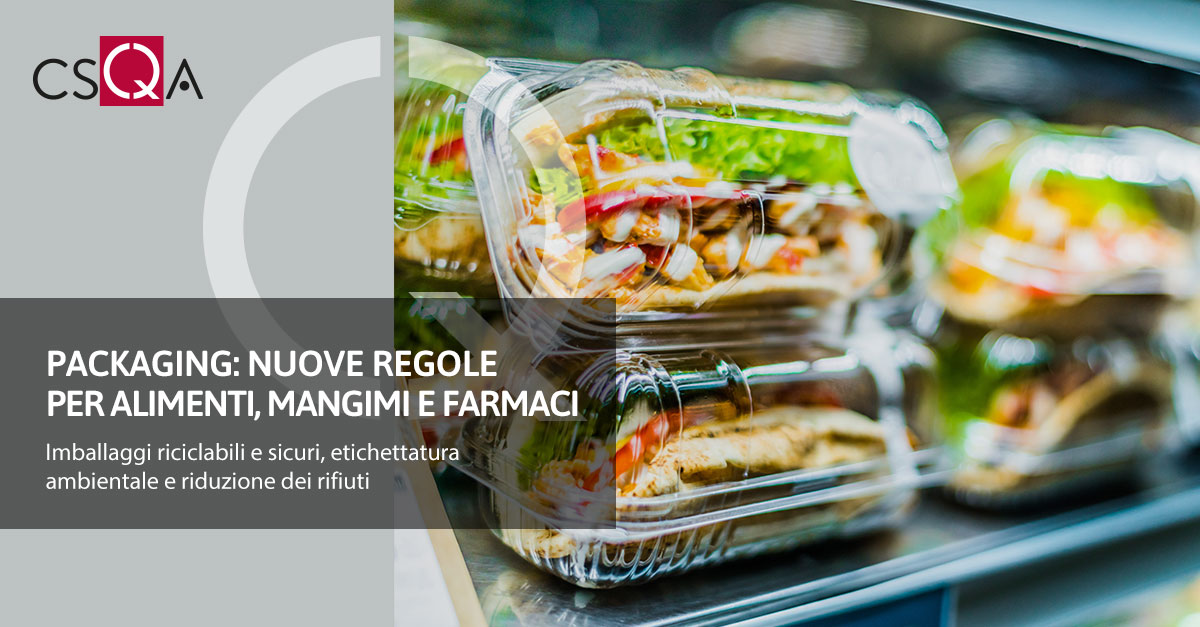
 With the approval of the European Delegation Law , Parliament delegates the Government to adapt national legislation to Regulation (EU) 2025/40 on packaging.
The Government is empowered to adopt, within eight months of the date of entry into force of this law, one or more legislative decrees to adapt national legislation to the provisions of Regulation (EU) 2025/40. This adaptation includes the introduction of sanctions and the identification of the national authorities responsible for the application, control, supervision, and collection of data required by Regulation (EU) 2025/40.
The PPWR Regulation
From 12 August 2026, the new Regulation on Packaging and Packaging Waste ( PPWR ) will come into full force in the European Union , introducing more stringent obligations for packaging, particularly in the food sector.The legislation imposes new recyclability requirements, the minimum use of recycled plastic, and limits on certain types of single-use packaging, with the aim of reducing waste production and standardizing rules across the European market.
The measure, formalized with Regulation (EU) 2025/40, was definitively approved by the Council of the European Union in December 2024 and published in the Official Journal of the EU in January 2025.
Unlike the previous Packaging Directive, the new legal instrument is a regulation and will therefore be directly applicable in all Member States without the need for national transposition.
Objective: reduce packaging waste
The initiative is part of the European Green Deal's environmental policies and circular economy strategies. According to European data, packaging waste has increased faster than economic growth in recent years, putting pressure on collection and recycling systems.The new regulation sets binding per capita waste reduction targets compared to 2018 levels:
- 5% by 2030
- 10% by 2035
- 15% by 2040
Recyclable packaging by 2030
Among the main changes is the requirement that all packaging sold in the EU be recyclable by 2030.Furthermore, from 2035, recyclability will have to be demonstrated on an industrial scale , i.e. through actually operational recycling systems.
The regulation also introduces minimum recycled plastic quotas for certain categories of plastic packaging .
In the food sector, the issue is particularly sensitive because the materials must comply with European standards for products intended to come into contact with food.
Limitations on single-use and more reuse
The PPWR also addresses single-use packaging considered avoidable, particularly for out-of-home consumption and single-serve packaging. At the same time, the legislation promotes reuse models and refill systems , as well as strengthening deposit systems for plastic and metal beverage containers.The measures also include restrictions on certain chemicals in packaging, including PFAS above certain thresholds in food contact materials.
Impact on the food supply chain
The new rules will have consequences along the entire agri-food supply chain, from packaging design to end-of-life management .Companies will have to adapt materials, designs, and distribution systems, while for consumers, container formats and return methods may change.
The debate between industry and institutions remains open: on the one hand, the regulation is considered a key step towards a circular economy , on the other, some industry associations are reporting critical issues related to the availability of recycled plastic suitable for food contact and the costs of compliance.
With the entry into force of the PPWR, packaging becomes one of the main areas of intervention in European sustainability policies, with direct effects on the entire food system. (Source: https://www.tecnoedizioni.com/ )