
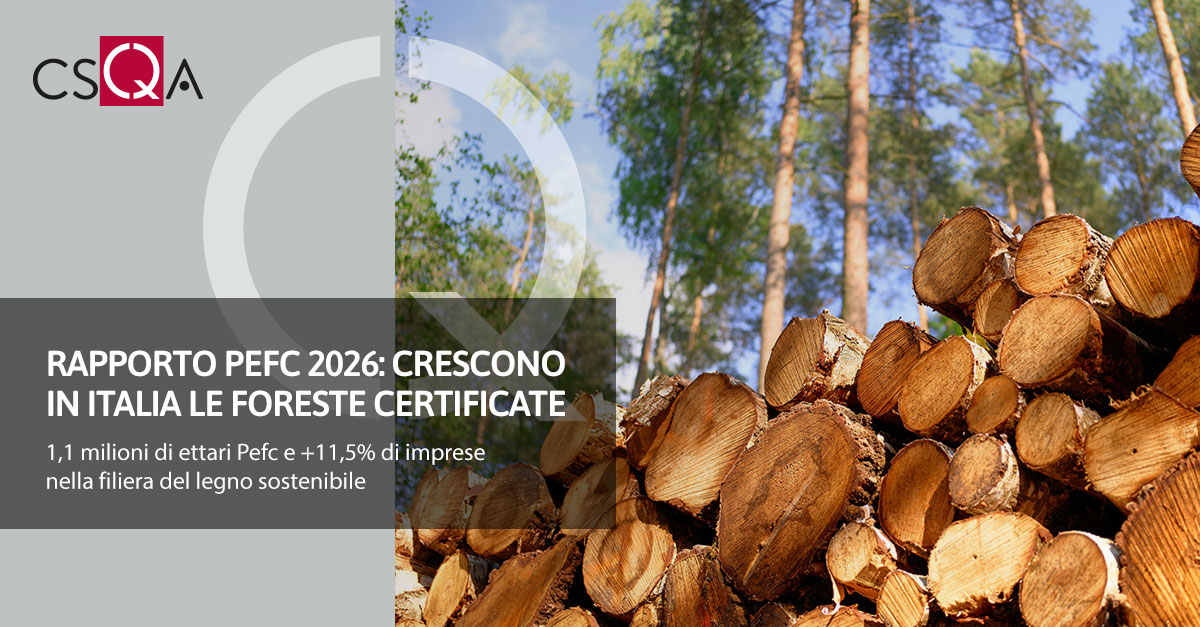
 PEFC Italy presents its 2026 Report , which outlines a 2025 consolidation of sustainable forest certification in Italy , both in forest management and along the transformation supply chains.
Sustainable forest management in Italy is no longer a niche but a growing infrastructure. The PEFC 2026 Report captures a sector growing in size and economic and environmental impact, from biodiversity protection to biomass energy to construction.
At the end of the year, the PEFC- certified forest area reached 1,124,507.48 hectares, an increase of 63,447.98 hectares compared to 2024 ( +6% ), steadily exceeding the threshold of 1.1 million hectares, while companies with Chain of Custody (CoC) certification rose from 1,585 to 1,735 thanks to 183 new entries, equal to an increase of 11.5%, the second-best result ever for new certified companies in a single year.
Three new regions in forest certification
Furthermore, in 2025, three new regions – Campania, Puglia, and Molise – will enter the forestry certification system for the first time. PEFC sees this as a sign of structural growth in the system and the positive involvement of local areas, businesses, and supply chains, within a framework further strengthened by the impact of public policies, particularly the Minimum Environmental Criteria for construction, and compliance with European directives.Supporting this picture, the report also highlights the almost doubling of the areas covered by ecosystem services certification compared to 2024 and the sharp increase in companies producing energy from wood and cellulosic material , which grew by 85.7% over the course of the year.
The ranking of PEFC certified forests
At a territorial level, in 2025 there will be 16 regions with at least one PEFC-certified forest ; Trentino-Alto Adige remains first with 597,729.69 hectares, followed by Piedmont with 103,113.89 hectares and Friuli-Venezia Giulia with 102,187.85 hectares.The system was extended to the new regions on August 27 in Campania with the 6,063 hectares of the Bussento-Lambro and Mingardo Mountain Community (Salerno), on October 7 in Puglia with the first 65.8 hectares certified in Foggia, and on November 17 in Molise with the Matese Forestry Consortium, 4,418.74 hectares in the province of Campobasso.
Overall, the certified areas are distributed over 1,000,442.69 hectares in the North , 108,490.08 in the Centre and 14,086.90 between the South and the Islands.
PEFC also reports that Piedmont has overtaken Friuli-Venezia Giulia and that there has been widespread growth, particularly evident in Central Italy.
On the ecosystem services front, eight new certifications were issued in 2025: four for carbon, three for tourism, and one for forest health ; the declared total rises to 39 certifications, with 22 for climate function, 8 for tourism-recreational function, 4 for health and well-being function, and 3 for biodiversity.
Construction remains a leading sector, driven by CAM (Certified Building Materials ) and the demand for certified materials on public construction sites. Growth is particularly evident in window frames (+28%), office, graphic, and specialty paper (+24.6%), wooden packaging (+23.8%), and pallets (+23.1%).
The number of companies producing energy from wood and cellulosic materials has risen to 13 (+85.7%), a trend potentially linked to the RED III regulation and the launch of the voluntary PEFC RED III certification recognized by the European Commission.
In terms of number of CoC companies, Veneto leads with 356 companies , ahead of Lombardy (284) and Trentino-Alto Adige (251); the largest annual increase is still in Veneto (+38), followed by Piedmont (+32) and Lombardy (+24).
In Central Italy, Tuscany leads the way, with 98 companies and the main contribution to annual growth, while in Southern Italy, Sicily stands out with 8 new certified companies.
« PEFC certification is not only a guarantee tool, but an enabling factor for the evolution of forestry and industrial supply chains towards models increasingly oriented towards sustainability and transparency of supply chains, in compliance with European obligations» , explains the general secretary of PEFC Italy Antonio Brunori .
And he specifies: "In a context where responsible forest management is increasingly central to environmental and climate policies, certification represents concrete support for businesses and regions in upgrading supply chains and enhancing the environmental, economic, and social benefits generated by sustainably managed forests ."