
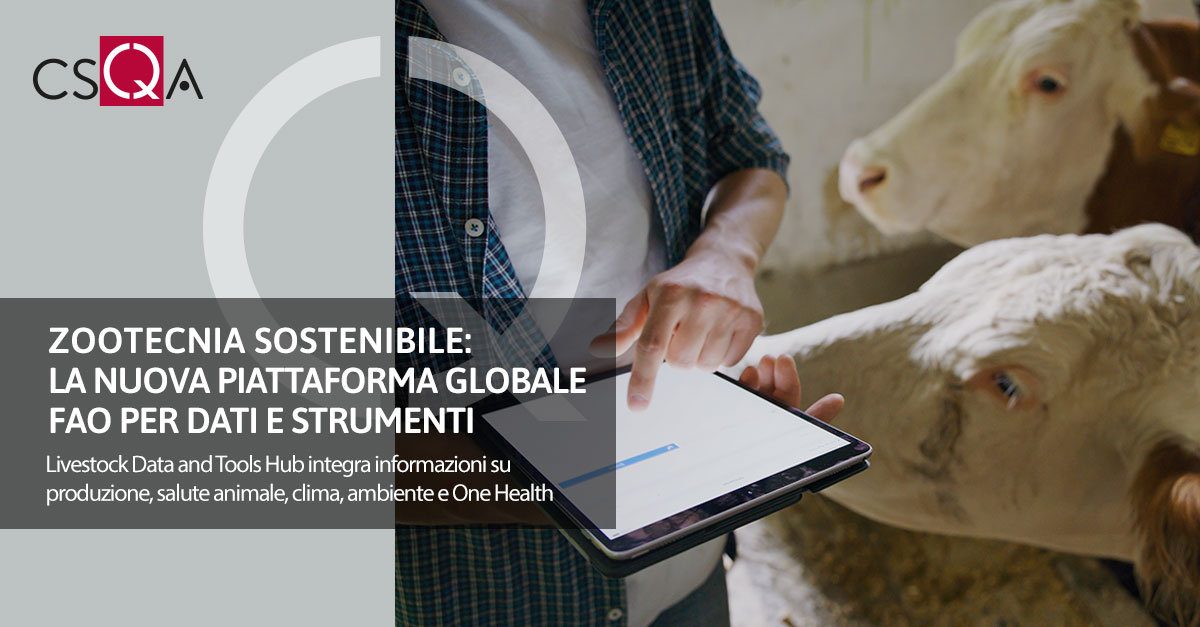
 FAO has launched the new Livestock Data and Tools Hub , an online platform designed to provide a single point of access to data, tools and knowledge dedicated to the livestock sector.
The new Hub was presented on 21 September 2026, during the Global Conference for Actions on One Health in Agrifood Systems, organized by FAO to promote an integrated approach to the health of people, animals, plants and ecosystems.
A single point of access to livestock data
The Sustainable Livestock Transformation and One Health Intelligence & Knowledge Hub was created with the aim of overcoming information fragmentation and making data and tools useful for understanding and managing livestock systems more readily available .Through dashboards organized by topic and geographic area , users can access and combine information relating to different areas, including:
- livestock production;
- animal health risks;
- antimicrobial resistance (AMR);
- interactions between breeding, climate and environment;
- economic and social aspects related to the sector.
The Livestock AI Assistant is also coming
Among the Hub's innovative elements is the Livestock AI Assistant , an artificial intelligence-based tool developed to facilitate navigation through the information, resources and tools made available within the various FAO activities dedicated to livestock.The goal is to simplify access to a vast wealth of information and promote the effective use of data to support decisions.
Data for prevention, sustainability and planning
The value of the new Hub lies above all in the possibility of connecting information from different fields.According to FAO, better access to and use of data can help strengthen early warning systems, improve risk preparedness, and support evidence-based decisions.
The information collected can also provide a stronger basis for policies, investments, and strategic planning, contributing to the transition towards more efficient, inclusive, resilient, and sustainable agri-food systems.
What opportunities are there for livestock farms?
For companies and operators in the livestock supply chain, tools of this type are particularly important in a context where data, measurement, and the ability to demonstrate performance are becoming increasingly important.Integrating information on production, animal health, climate, environment, and socioeconomic aspects can support the analysis of risks and trends affecting the sector and provide useful insights for guiding sustainability and resilience strategies.
The availability of structured and comparable data can also represent a growing support for companies called upon to measure and document aspects such as environmental performance, emissions, resource use, animal health and welfare, and supply chain risk management.
The launch of the Livestock Data and Tools Hub thus confirms a trend that has become central to the livestock sector: transforming data into a concrete tool for knowledge and decision-making, increasingly integrating productivity, animal health, environmental sustainability, and the One Health approach.