
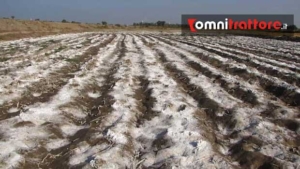
In the European Union and the United Kingdom , soil salinization already affects a significant portion of agricultural land, with estimates from the Joint Research Centre and other European institutions indicating between one and three million hectares affected. This is within a broader context in which approximately 63% of European soils are degraded for various reasons, including the accumulation of salts in irrigated coastal lands.
In Salento, agricultural desertification, water scarcity, and the advance of salt in the soil have contributed to classifying the area as disadvantaged, with heavy losses to olive groves. In the Polesine area, the phenomenon has a precise technical name—salt wedge—and an operational project, GO CUNEOSOL, which on September 16 brought together experts on solar energy and biochar for soil recovery.
[…]
Alongside alternative crops, the CSQA guidelines on agricultural land degradation recommend interventions that can already be implemented with existing farm equipment: water management that promotes infiltration without stagnation, improved field drainage, a reduction in intensive tillage, and the use of organic soil improvers to combat salinization and sodicization.
On the irrigation front, the choice of volumes and rotations remains as crucial as water quality: an excess or deficiency compared to the crop's actual needs worsens both salt and water stress, as also emerged from the work on tomato irrigation volumes and production yield . In parallel, monitoring electrical conductivity and soil moisture allows for the detection of salt accumulation before it becomes visible on the crop, integrating sensors with the decision support systems already discussed in connection with root monitoring and transplant stress .
[…]
Source: Omni trattoria.it