
 The project , financed by the SRG08 intervention of the Regional Complement for Rural Development 23/27, was launched in June 2025 by the Institut Agricole Régional (IAR) in collaboration with Cave Mont Blanc de Morgex et La Salle, Coldiretti Valle d'Aosta, the Municipality of Nus, CSQA and the Mont Avic Natural Park , with the aim of developing a certification model capable of recognizing and concretely valorizing the commitment of agricultural companies in the protection of biodiversity.
A key element of the project was the specialized training of future inspectors, who were required to ensure scientific rigor, methodological consistency, and reliability in the protocol's application.
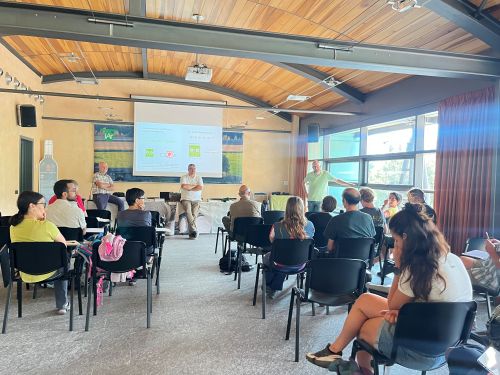 16 technicians were involved in the practical training course and, at the end of the two days and after passing the final exam, obtained the qualification of Biodiversity Friend® inspectors .
The participants , belonging to the project partnership, to the Department of Agriculture of the Autonomous Region of Valle d'Aosta and to various Orders of Agronomists and Forestry Doctors (ODAF) and Biologists, came from Valle d'Aosta, Piedmont, Lombardy, Liguria and Friuli-Venezia Giulia , confirming the growing national interest in innovative environmental certification tools applied to mountain agriculture.
Training between classroom and field
The first day took place at the Institut Agricole Régional in Aosta, with an in-depth study of the Biodiversity Friend® Prati-Pascoli module, with particular attention to phytosociological surveys and expedient floristic indices.In the afternoon, the training moved to the IAR summer stable in Saint-Oyen , where participants applied biodiversity assessment indices relating to water, soil, air and vegetation.
The second day was entirely dedicated to practical activities in the Saint-Barthélemy Valley , in the municipality of Nus. The technicians put the assessment tools into practice directly in agricultural and pastoral environments, meeting with breeder Luca Elex and visiting the Veplace mountain pasture.
The course concluded with a moment of analysis and feedback on the activities carried out, followed by the final exam that allowed participants to obtain the qualification of Biodiversity Friend® inspectors.
"This training program represented a fundamental step in building a network of professionals capable of reading and interpreting the biodiversity of mountain agroecosystems with shared scientific tools," emphasized Mauro Bassignana of the Institut Agricole Régional . "The Aosta Valley has confirmed its position as an advanced laboratory for innovation in sustainable agriculture."
For Roberto Bianco, Director of Coldiretti Valle d'Aosta, the initiative "has strengthened the link between agriculture and the local area, enhancing the role of farmers and farms as active custodians of biodiversity and the Alpine landscape."
Finally, according to Luca Valdetara of CSQA , «the training of inspectors has represented a key element in guaranteeing the credibility and solidity of the certification systems , ensuring high and recognisable standards at national and international level».
A strategic investment for the future of mountain agriculture
Training was one of the project's most valuable elements, enabling the development of advanced and shared technical skills for assessing biodiversity in Alpine ecosystems.Through fieldwork and a multidisciplinary approach, the new inspectors will help ensure quality, transparency, and consistency in certification processes , offering agricultural companies a concrete tool to enhance their environmental commitment and strengthen the competitiveness of local production.
The project confirmed that investing in training means investing in land protection, biodiversity conservation, and the sustainable development of mountain agriculture, laying the foundation for an increasingly robust and recognized certification system.