
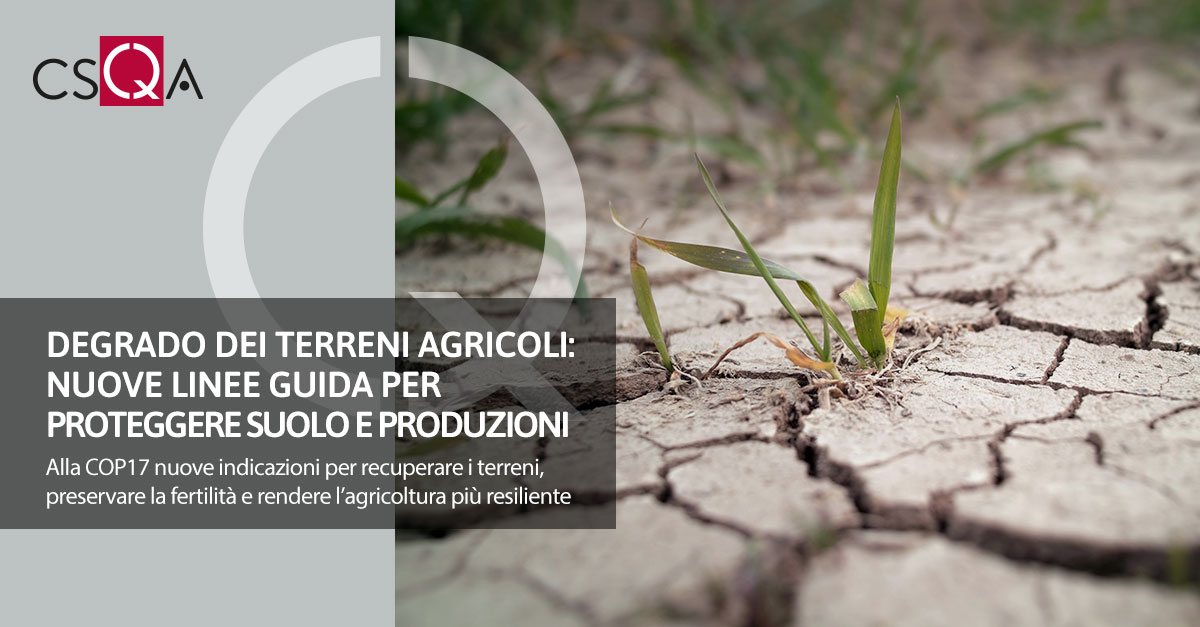
At COP17, FAO and UNCCD launch new guidelines to tackle agricultural land degradation. Sustainable soil management, resource protection and practices aimed at strengthening farm productivity and resilience are at the heart of the new approach.
Soil degradation continues to worsen globally, while available solutions to prevent and tackle it are still not being adopted quickly or widely enough.
This is one of the key findings of the new analysis presented by the Food and Agriculture Organization of the United Nations (FAO) at COP17 of the United Nations Convention to Combat Desertification (UNCCD), held in Ulaanbaatar, Mongolia, from 17 to 28 August 2026.
According to FAO, 1.66 billion hectares of land worldwide are affected by human-induced degradation, and more than 60% of this area – approximately one billion hectares – consists of agricultural land, including cropland and pastures.
The latest data also confirm a worrying trend: based on regional and subregional assessments covering 75 countries, 58% report a deterioration in soil conditions since 2015, while only 10% report an improvement.
Soil erosion remains the main threat
Among the different forms of soil degradation, soil erosion remains the most serious threat, with 65% of the assessments examined by FAO reporting worsening conditions.
For farms, the consequences can be significant. The loss of fertile topsoil, together with declining organic matter, compaction, salinization and loss of biodiversity, can undermine soil fertility and its ability to retain water and nutrients.
Soil degradation is therefore not only an environmental issue: it can directly affect productivity, farm costs and the ability of agricultural businesses to cope with drought and extreme weather events.
The new FAO-UNCCD guidelines
At COP17, FAO and UNCCD presented the new “Living Soils, Productive Lands, Resilient Landscapes: Guidance on avoiding, reducing and reversing agricultural land and soil degradation”.
The document provides a scientific and operational framework for governments, agricultural stakeholders and other actors involved in land management.
The approach follows three priorities: avoiding degradation where land and soils are still in good condition, reducing ongoing degradation processes and reversing degradation by restoring affected agricultural land and soils.
The guidelines also promote an integrated approach: soil health should be addressed together with water management, biodiversity, production systems, land-use planning and the economic and social conditions of rural communities.
Eleven priorities for protecting soil
Within this framework, FAO's recommendations for sustainable soil management identify 11 key areas for action:
- Minimize soil erosion, preventing the loss of fertile topsoil caused by water and wind.
- Maintain and improve soil structure, limiting compaction and other processes that can reduce soil porosity, water infiltration and root development.
- Ensure adequate soil cover, using vegetation and crop residues to protect soil from erosion and support water conservation.
- Maintain or increase soil organic matter and soil organic carbon, which are essential for fertility, soil structure, biodiversity and water retention.
- Ensure an appropriate nutrient balance, replacing nutrient losses and meeting crop requirements while avoiding excessive inputs and losses to the environment.
- Prevent and reduce soil salinization and sodification, which can adversely affect soil structure and productivity, particularly in irrigated areas and regions exposed to water scarcity.
- Manage soil water effectively, promoting infiltration and water availability for crops while preventing waterlogging and drainage problems.
- Prevent and reduce soil contamination, limiting the accumulation of substances that may harm crops, soil organisms, ecosystems and human health.
- Protect soil biodiversity, preserving the organisms and biological processes that contribute to fertility, nutrient cycling and the functioning of agricultural ecosystems.
- Manage inputs and soil amendments safely and responsibly, promoting appropriate use of organic resources and nutrients while minimizing potential risks to soil and the environment.
- Limit soil sealing and the loss of agricultural land, protecting productive areas and the ecosystem functions they provide.
What practices can farms adopt?
The general principles translate into practical solutions that can be implemented in the field. FAO highlights a range of sustainable soil management practices that are already available and proven and can help tackle degradation while maintaining agricultural productivity.
These include, in particular, reduced tillage, integrated nutrient management, crop diversification, the use of organic amendments and agroforestry.
Reduced tillage can help preserve soil structure and organic matter; crop rotations and diversification can support fertility and biodiversity; and more efficient nutrient management can meet crop needs while reducing losses and excessive inputs. Organic amendments can improve the physical and biological properties of soils, while agroforestry systems integrate crops with trees and woody vegetation, contributing to soil protection and greater diversification of production systems.
However, there is no single solution suitable for every farm. FAO stresses the need to adapt practices to soil characteristics, climate, crops, water availability and specific socioeconomic conditions.
The challenge is also the pace of adoption
One of the key issues highlighted by FAO's latest analysis is the gap between the availability of technical solutions and their actual implementation.
In more than half of the regional and subregional assessments covering the 75 countries considered, the adoption of sustainable soil management practices was rated as low or very low.
The challenge, therefore, is not only to identify new solutions but also to implement existing ones on a much wider scale, creating favourable conditions through training, technical assistance, coherent policies, economic instruments and investment.
Protecting soil means protecting the farm
For agricultural businesses, the message emerging from COP17 is clear: soil health is closely linked to the ability to produce and to maintain that productive capacity over time.
Tackling erosion and compaction, preserving organic matter, using water and nutrients efficiently and increasing the diversification of production systems means addressing factors that directly affect soil fertility and farm resilience.
Sustainable soil management therefore has not only an environmental value but also an agronomic and economic one. Protecting soil means safeguarding one of a farm's most important productive assets and strengthening its ability to respond to climate change and increasing pressure on natural resources.